

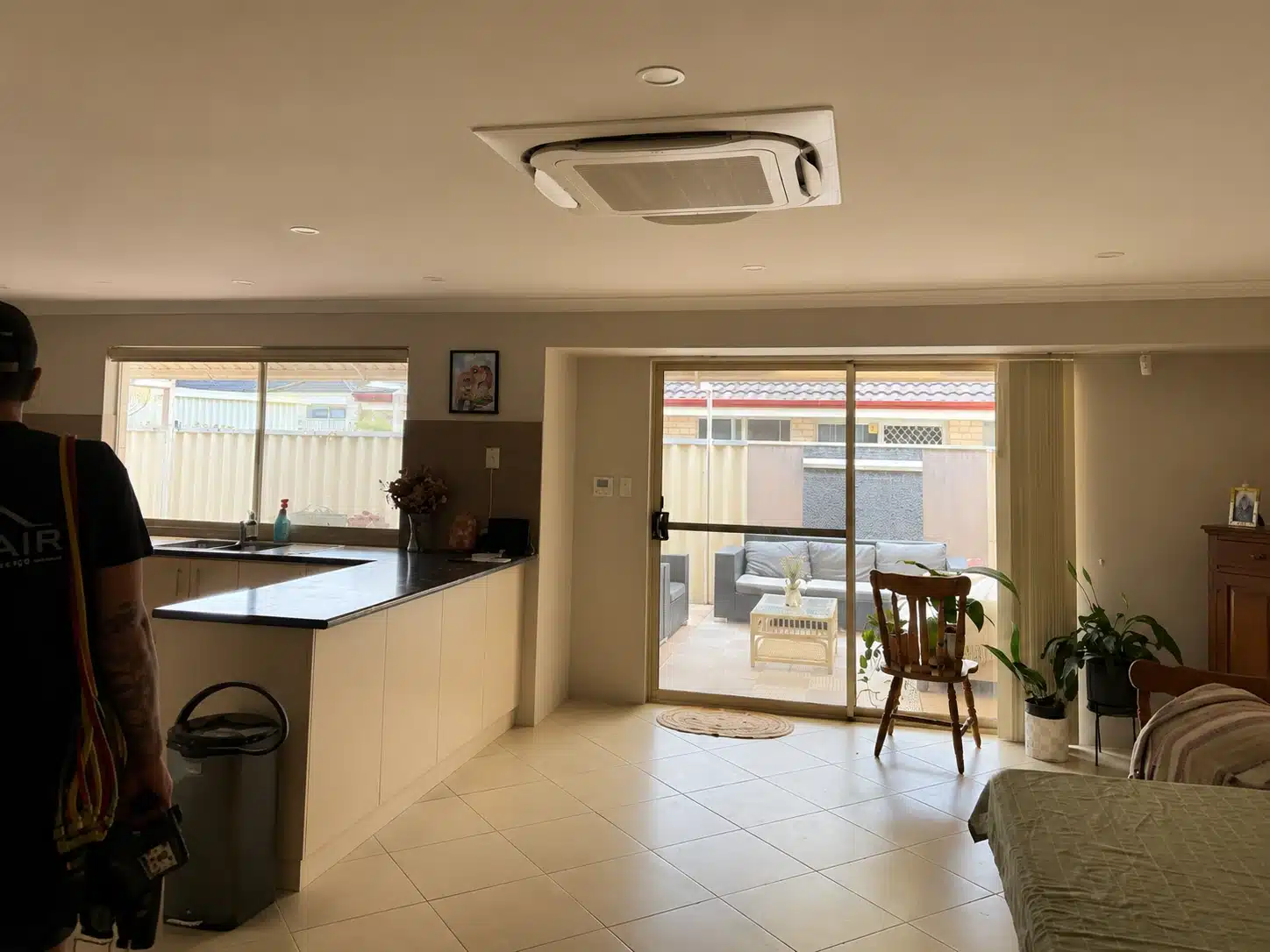
Cassette mini split systems are becoming a popular choice in Perth homes, especially for people who want powerful cooling without a bulky unit hanging on the wall. Imagine walking into your living room after a brutal 38°C summer day and feeling cool air spread evenly across the space instead of blasting directly into your face. That smooth airflow is one reason many homeowners now prefer ceiling-mounted systems over traditional wall units.
In modern homes, the debate between wall-mounted AC units and a cassette mini split often comes down to comfort, style, and long-term energy savings. Many Perth homeowners are now looking for air conditioning systems that blend into modern interiors while still delivering strong cooling performance during harsh Australian summers.
While both systems use inverter technology, they perform differently depending on room size, airflow, and how often you run the system.
What is a Cassette Mini Split?
Think of a cassette mini split as an air conditioner that’s gone undercover – almost invisible, because it’s recessed into your ceiling. These systems are also called ductless cassette mini splits or ceiling-mounted mini splits. Inside the ceiling space, the unit’s compact body is hidden, and only a slim decorative grille is visible.
Unlike a wall unit that pushes air one way, a cassette fan has vents on four sides, sending air in 360° patterns. This multi-directional airflow means the cool or warm air fills the room more evenly, which is why many Perth homeowners prefer a cassette mini split for large living areas and open-plan homes.
In fact, Mitsubishi’s four-way cassette “ensures even, efficient comfort”. Cassette units are ideal for large open-plan areas or office spaces where you want smooth airflow without cluttering the walls. They operate whisper-quiet and often come with smart controls. The trade-off? Installation is more complex – you need room above the ceiling for the unit and refrigerant lines. A qualified HVAC installer will also need to run condensate drains and possibly a foam insulation kit for the ceiling. But once fitted, a cassette mini split is pretty low-profile and stylish.
What is a Wall-Mounted Mini Split?
A wall-mounted AC (also called a wall-mounted mini split) is the more familiar sight in Aussie homes and shops. You often see these slim units mounted high on a wall (near the ceiling). They connect to an outdoor condenser via a small conduit through the wall. These systems push air out of one grille, so the airflow is unidirectional.
Wall units are very popular because they’re easy and cheap to install – all you really need is a 75mm hole in an exterior wall for the pipework and wiring. Brands like Mitsubishi and Daikin make wall units with high SEER ratings (some models up to 19-26 SEER). Wall units also often have smart thermostats and low noise levels.
They won’t win any stealth design awards (they do stick out on the wall), but they’re compact and great for targeted cooling. Young pros in Perth might install a wall AC in a home office or apartment bedroom where budget and ease are priorities.
Here’s a typical cassette mini split unit (left) and a wall-mounted unit (right). Both look sleek, but the cassette hides above the ceiling while the wall unit is front-and-centre.
Efficiency and Energy Ratings
In Australia, both cassette mini splits and wall units can boast excellent efficiency. These are modern inverter-driven heat pumps, so each can achieve 5‑star, 7‑star or even 10-star energy ratings, especially in cooling-dominated climates like Perth’s.
Both unit types are required to carry Energy Rating labels showing stars (blue for cooling) that measure their Energy Efficient Ratio (EER) for cooling and Coefficient of Performance (COP) for heating. These stars give you a quick compare. In fact, Perth is hot – February highs average about 31.7 °C – so picking a high-star-rated AC is wise regardless of type.
The Australian government’s new Zoned Energy Rating Label even accounts for climate differences, noting that “the performance of air conditioners is affected by the climate in which it is operating”. In other words, an AC in Perth’s dry heat works harder than in Sydney’s milder climate. So both wall units and ceiling cassettes must deliver the same cooling output while drawing as little power as possible.
Often, the SEER rating comes down to the outdoor unit and compressor technology, not just the indoor style. Manufacturers like Mitsubishi confirm this: a top-line cassette and a top-line wall unit (if paired with the same outdoor unit) can have nearly identical efficiency ratings.
For example, a Mitsubishi four-way cassette unit is designed for “efficient comfort” and easy maintenance, while their wall units are promoted as efficient heat pumps.
In practical terms, you’ll find many efficient cassette mini split models in the 8–12 kW range with impressive 5-9 star energy ratings. Modern wall-mounted systems can achieve similar efficiency levels too, especially when paired with advanced inverter compressors and smart temperature controls that reduce unnecessary power usage.
Higher star ratings can make a noticeable difference to electricity bills over time, particularly during Perth’s long and hot summers when cooling systems run for hours every day. Homeowners comparing systems can also explore helpful Energy Saving Tips to better understand how energy-efficient air conditioners help reduce long-term running costs in Australian homes.
In short: both ceiling cassette mini splits and wall-mounted units can be very efficient, but you must compare specific models. The key differences lie not in raw efficiency, but in how they deliver comfort.
Airflow and Coverage
One real advantage of cassette mini splits is how they distribute air. As one HVAC guide notes, “ceiling cassettes achieve better, more uniform airflow and coverage than wall mount units” because the air is blown in four directions. Imagine a quiet fan in the ceiling slowly sweeping air outward like a gentle storm. This is great in large spaces or open-plan rooms – you avoid cold or hot pockets. A cassette will cool a family room evenly from the center.
Wall units, in contrast, push air forward from one wall. They create a strong breeze in that direction, which can quickly cool the air in its path (useful for a bedroom). But beyond the beam of air, circulation relies on room acoustics and fans. So for uneven spaces (with furniture or partitions), a wall AC might require multiple units or fan assistance to avoid dead zones.
Ceiling cassettes – better for big, open rooms (four-way flow).
Wall units – better for smaller zones (single vent flow).
Installation and Costs
Here’s where the differences really show up. Ceiling cassette mini splits have higher upfront costs. The unit itself can be pricier, and installation is more complex. As one installer guide points out, cassette installation is tricky because you need clear ceiling joist space and attic clearance. Plumbers must connect the piping and condensate drain through the roof or ceiling. This often means a longer labor time and maybe even reinforcing the ceiling structure.
On the other hand, wall-mounted units are straightforward to fit on any sturdy wall. A single 75 mm hole is drilled for pipes and power. No ceiling work is needed. Wall units from brands like Mitsubishi Electric are among “the most popular HVAC systems… easy to install and maintain, leading to cost savings”. In practice, installers often quote that wall units can cost 30–40% less to install than ceiling cassettes.
In terms of maintenance, wall units also win points. Filters and panels are at eye-level and can be cleaned without ladders. Cassettes hide in the ceiling, so periodic filter cleaning or servicing can require a pro with a scissor-lift (especially in commercial sites). So expect some extra service cost for ceiling units.
Cost summary:
- Cassette mini split: higher purchase price, complex install, higher install labor cost.
- Wall-mounted AC: lower cost unit, simple install, cheaper labor.
The extra cost of a cassette might be worth it for a polished look or efficient multi-zone cooling. But for tight budgets, a wall unit is hard to beat on price.
Running Costs in Perth’s Climate
Once installed, how much energy they use day-to-day is what really matters to your wallet. In cooling mode (the main mode in Perth’s long summers), both systems will draw similar power if they have similar capacity. For example, a 6.6 kW cooling cassette and a 6.6 kW wall unit of the same series might each use around 1700–2000 W at max output.
However, because cassettes distribute air all around, they can often reach the room’s set temperature with slightly less on/off cycling than a single-direction wall unit might. This potentially translates to marginal savings in large spaces.
In short, neither has a magical efficiency advantage – their energy draw depends largely on their inverter technology and how long they run, which is governed by your thermostat setting.
What the context really changes is user behaviour and design. For a big open-plan area (e.g. a combined kitchen/living), one cassette might cool the whole zone evenly. If you tried the same with one wall unit, you might run it longer or add a second unit, bumping up total power use. Conversely, in a smaller bedroom, a single cassette would be overkill – a wall unit sized to the room would use less power.
Perth’s hot, dry summers (often topping 35–40 °C) mean you’ll run the AC heavily, so small efficiency gains matter. Both unit types can reach 9–10 stars on the latest label for cooling in Perth’s “hot zone” label. In fact, ActronAir notes that choosing a higher-star unit can save you hundreds of dollars per year.
For example, moving from a 3-star to a 6-star unit of the same size nearly doubles efficiency. So rather than worrying only about cassette vs wall, focus on finding a high-star-rated cassette mini split or a high-star wall unit that suits your space.
Power Bills: Expect running costs to be in the same ballpark for cassette vs wall if capacities and usage hours are the same. Some installers even say “in reality, there may be very little difference in running costs between them.” The big savings come from good insulation, correct sizing, and an efficient unit overall.
Feature Comparison Table
The table below summarizes key differences to help you decide:
|
Feature |
Cassette Mini Split | Wall-Mounted AC |
|
Energy Efficiency |
Very high (often 7–10 stars); even 4-way airflow spreads cooling efficiently. | Also very high (many models 7–10 stars); directed cooling. |
| Airflow Pattern | Multi-directional (4-way) for uniform coverage. |
One-directional; strong focused airflow. |
| Ideal Room Type |
Large open-plan areas, offices. |
Small/medium rooms (bedrooms, studies). |
|
Aesthetics |
Discreet (flush in ceiling) – minimalist look. | Visible on wall (blends if matched to room style). |
|
Installation |
Complex: needs ceiling cavity, joist space and condensate line. | Simple: one wall hole for pipe and cable. |
|
Upfront Cost |
Higher unit price + higher install labor. |
Lower unit cost + quick (cheaper) install. |
| Maintenance | Filters up in ceiling – may need a pro for cleaning. |
Easy DIY access to filters on wall unit. |
| Noise Level | Very quiet (ductless inverter tech); cassette can be even quieter. |
Very quiet too; modern wall units are whisper-quiet. |
Conclusion
In short, both cassette mini splits and wall-mounted ACs can be extremely efficient when chosen wisely. A high-end ceiling cassette and a high-end wall unit from the same brand can have nearly identical efficiency ratings.
The main differences lie in how they deliver comfort. Cassette units excel at evenly cooling large, open spaces and look ultra-sleek hidden in your ceiling. Wall units win on cost, ease of install, and are ideal for smaller rooms or tight budgets. In Perth’s climate – with blazing summers – what really matters is picking a properly sized system and a high-star rating, and having it installed correctly.
Whether you go with a cassette mini split or a wall-mounted unit, you’re getting modern inverter AC with energy-saving features. Think of it like choosing between a luxury sedan (cassette) and a sporty hatchback (wall unit): both get you where you want efficiently, but one is more upscale (and more expensive) while the other is practical and efficient.
If money and access allow, a cassette mini split gives that “just-look-at-that-ceiling” wow factor and even airflow. If you need affordability and simplicity, a wall unit won’t disappoint and will keep you just as cool.
After weighing your room layout, budget and style, you’re armed to pick the best option. And remember – always check the energy star label (and look up the EER/COP) when comparing models. For more on how AC efficiency is rated in Australia, see the Australian Government’s energy rating info.
FAQs
-
What is the main difference between a cassette mini split and a wall-mounted AC?
A cassette mini split is installed inside the ceiling and spreads air in four directions for even cooling. A wall-mounted AC sits on the wall and pushes air mainly in one direction, making it better for smaller rooms.
-
Which is more energy efficient?
Both systems can be highly efficient when they use inverter technology and high star ratings. The real energy savings depend more on the unit size, usage habits, and energy rating than the indoor design itself.
-
Are cassette mini splits quieter than wall units?
Yes, many cassette mini split systems run slightly quieter because the indoor unit is hidden in the ceiling. However, modern wall-mounted systems are also very quiet and suitable for bedrooms or home offices.
-
Is installing a ceiling cassette in an existing home difficult?
Installing a ceiling cassette mini split can be more complicated because it needs ceiling space for pipes and drainage. Wall-mounted units are easier and faster to install in most existing Perth homes.
-
Which system costs less to run?
Running costs are usually very similar if both units have the same cooling capacity and efficiency rating. In Perth’s hot summers, choosing a properly sized high-efficiency system matters more than the style of the unit.
